Wealth and Investing for Travel Nurses
If you became a travel nurse with the goal of making money and building wealth, but feel lost when it comes to investing and money management, this article is for you. .
In this article, we will walk through two parts:
- The basics of money management: Establish and emergency fund and pay down debt
- Investing to grow wealth: including where and what to invest in (even if you don’t have a 401k option).
If you want to go ahead and dive in, click on the links above to jump down to the meat of this article. That said, I do recommend taking the time to read through this and continuing on to build your own financial literacy. Speaking of continuing to build your financial literacy, I have recommendations at the bottom of this article with books and resources that helped me understand my finances.
The Power of Compound Interest
Before we discuss money management and investing, it is important that you understand compound interest. Essentially, compound interest is the “why” behind why you should avoid debt and why you should start investing as soon as possible.
Let’s look at an example: Imagine you invest $1000 and earn 5% interest. At the end of year 1, you will have earned $50. This brings your total to $1050. For year 2, you continue to invest, but include the earnings, so you invest the full $1050. This would give you a total of $1102.50 at the end of year 2. This cycle continues on growing your money exponentially without any extra work from you. The earlier you can start investing, the more time your money has to compound.
Compound interest is a double-edged sword, however, meaning that debt compounds negatively. Here is another example. Let’s say you have $1000 in credit card debt with an annual interest rate of 20%. After 1 year, your debt will have grown to $1219.64 and after 2 years your debt will be $2488.86. You have more than doubled the cost of whatever items you bought with your credit card. This is why getting out of debt (especially debt with a high interest rate like credit card debt) is so important to your overall financial picture.
Keeping these two goals in mind- avoid debt and invest early to have compound interest work for you, not against you -lets move on to the steps you need to take to accomplish these goals.
The Basics of Money Management
Before you starting investing your money, there are 3 things you should do (including getting out of debt) to ensure you are getting the most out of your money. I’ll explain in more detail below, but first, here is an infographic to make it a little easier to remember:

Step 1: Emergency Fund
A good rule of thumb is to have 3-6 months of living expenses saved as an emergency fund. This means taking the time to track what you spend each month so that you can get an accurate number.
Keep your emergency fund in a high interest savings account. Online banks tend to offer higher earnings for savings accounts than brick and mortar banks. Just make sure that the bank you choose is FDIC insured (meaning your savings are protected by the government should anything happen to the bank).
Travel nursing can be a pretty unstable source of income. Your contract could get cancelled at a moments notice, or it could take longer to start a new contract than expected. Because of this volatility, I lean more towards saving the 6 months of living expenses. If you have a spouse that has a stable income that would support necessary living expenses in the case you are out of work, or if you have a consistent PRN job to fall back on, you may be able to get away with 3 months as an emergency fund instead.
Your emergency fund is your protection from having to take on more debt. For example, if your contract gets unexpectedly cancelled, you need to have enough money in your emergency fund to get you through to the next contract without taking on debt. The same concept applies if your car breaks down, or you break your leg and can’t work.
One caveat here- if you already have very high interest debt (interest rates around 20% or above), it is advisable to pay off this debt before fully funding your emergency fund. For example, you could save just 1 month worth of expenses then shift your focus to the debt. Once the debt is paid off, make sure you go back and fund your emergency savings so that you don’t end up back in the same predicament.
Step 2: Get the 401k Match
Yes, I know this is technically investing, but it needs to be considered early on as it is free money. Don’t leave that on the table If you have the option, it is reasonable to go ahead and invest is order to get the 401k match prior to paying off debt. Keep in mind the caveat bolded above. It would not be a good idea to put this ahead of very high interest rate debt (such as credit card debt).
As a travel nurse, you may or may not have access to a 401k with a match. If you are not using an agency that offers a 401k and match, don’t worry, there are still plenty of great investing options that we will get to later. Feel free to skip down to step 3.
In case you were wondering, matching is the money that your employer contributes your 401k. Usually, it’s in terms of a percentage of what you contribute. For example, X company will match 100% of the first 3% that you contribute. It’s free money that you get just for putting money into your retirement account.
There’s a catch, however, especially for travel nurses (but it often applies to staff jobs too). The catch is the vesting period.
Vesting is the amount of time it takes for you to qualify for money that your employer matches (or adds) to your 401k. If you were to switch agencies before the vesting period ends, you would not receive the money the employer matched or contributed. You would still have the money you contributed.
The problem for travel nurses is that we often switch agencies (as we should be in order to get the best rates). The frequent employer changes can make it difficult to “vest”. Note that not every agency has a vesting period, but it is something to ask about when choosing an agency. In addition, some agencies have a period of time or number of hours you have to work with that agency in order to be able to contribute to a 401k plan in the first place.
In summary, contribute to your 401k prior to paying down debt if the following apply:
- You don’t have very high interest debt.
- Your agency offers a 401k with a match.
- There is not a vesting period to receive that match OR you expect to be with the agency long enough to vest.
Step 3: Pay down debt
After you have a healthy emergency savings, it’s time to pay down debt. Typically, this does not include trying to pay off your mortgage. Instead focus on paying down debt with interest rates near or above 7%.
Why 7%? On average, the stock market returns around 7% annually adjusted for inflation. This will vary year to year as it is an average taken over a long period of time. If you have debt that is charging you close to or more than this 7%, you will likely be losing more money than you would be able to make in the stock market. Also, paying off debt is a guaranteed way to increase your wealth. While I am 100% an advocate for investing, investing is not guaranteed.

Invest
Investing sounds daunting, but I’ll try to break it down here in a way that’s easy to understand. Most of this applies to everyone, not just travel nurses and allied travel professionals. I’ll include some caveats that are unique to our situation as travel healthcare professionals as well.
Terminology: Buckets and securities
When you invest your money, you put that money into an account. Within that account, you invest in a stock, bond, fund or similar asset.
For example, if you put money into your 401k, that is the bucket (that’s not a technical term, but for understanding, it makes the most sense to me). If in the 401k, you chose something like the “target retirement 2050 fund” or “Coca Cola stock”, that is the security.
Buckets
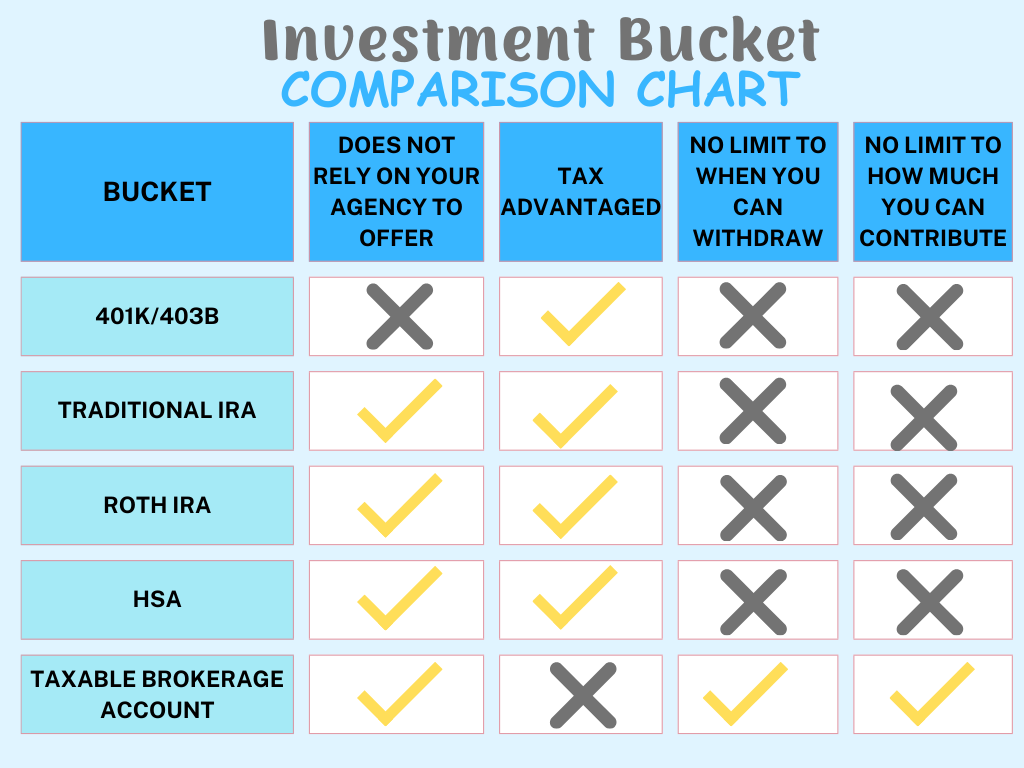
There are several buckets available to chose from with varying degrees of extra benefits like tax advantages. We will go through the major options here.
401k/403b
A 401k or 403b is a retirement plan offered by your employer. For the puposes of this article, I’ll use 401k and 403b interchangeably.
We already discussed this briefly in our money management section above. We reviewed definitions of matching and vesting as well as barriers travel nurses have in regards to 401k plans. If you are not using an agency that includes a 401k, don’t fret. There are more retirement planning and investing options that we will get to soon. If this is you, feel free to jump ahead to IRAs.
If you do qualify for a 401k, consider using this bucket to increase retirement savings and lower your taxable income. Let’s look at the pros and cons of this type of investment bucket.
401k/403b pros
- Tax advantaged
- You don’t have to pay taxes on the money that you contribute to your 401k. You will have to pay taxes on it later when you take the money out for use in retirement. This is still a good tax advantage because it means more money to earn interest and grow.
- Lowers your tax burden
- This goes hand in hand with the “tax advantaged” pro above, but takes it a step further. The more money you put into your 401k, the less money that is seen as income when it comes to your tax bracket. In short, this means you could pay a lower percentage of taxes by contributing more to your 401k.
- High contribution limit
- The amount of money you can contribute to your 401k varies slightly each year, but you are allowed to contribute significantly more here than you can to other common tax-advantaged accounts. For 2024, the max contribution is $23,000 per year.
401k/403b cons
- You won’t have access to this money until age 59.5 without hefty fees.
- Limited availability to travel nurses (due to many agencies not offering one)
- Potential for vesting periods as explained above
- Some 401ks have limited or subpar options for securities. We will get to more on securities later. For now, just know that you might not have as many choices for what to invest in within your 401k.
- After age 72, 401ks have required minimum distributions.
- This means you have to take out a certain percentage of your total investment whether or not you need it or want to use it.
- Why is this a problem? It can put you in a higher tax bracket since 401k distributions are taxed as income.
What to do if your agency does not offer a 401k
The answer to what to do if your agency does not offer a 401k will depend on your goals as an investor. Let’s look at some of these goals and what to do in each instance:

Individual Retirement account (IRA)- Roth or Traditional
IRAs are not linked to your employer, so you can contribute as a travel nurse regardless of which agency you choose. In order to create an IRA, you need to choose a brokerage (basically a bank for investments)- Vanguard and Fidelity are good, well-recognized options.
As the name implies, IRAs are meant to save for retirement. The rules on IRAs differ a little from 401ks/403bs. We will review those next, but first, let’s look at the difference between a Traditional IRA and a Roth IRA.
Traditional vs Roth IRA
The difference between a Traditional IRA and a Roth IRA has to do with the timing of the tax advantage.
The Traditional IRA functions much like the 401k. Money is tax free when it goes in, the tax-free investment grows, then all of the money is taxed when taken out for retirement.
Just a quick note here, some 401k plans do offer a Roth option. That is a less common scenario, but I wanted to point it out in case you see that. The main difference between a Roth 401k and a Roth IRA is the amount you can contribute.
The Roth IRA uses money that has already been taxed (just like your normal paycheck), it grows in your investment account, then it is not taxed again when taken out for retirement.
Rules for Traditional and Roth IRAs
Traditional IRA rules:
- You don’t have to rely on your agency to offer it.
- Lowers your tax burden if you (or your spouse) don’t have a 401k available through your employer.
- If you do have a 401k, you can still contribute, but you likely will not get the same tax deduction.
- The amount you can deduct from your taxes is lowered and eventually eliminated if you have a 401k and make more than $77k (single) or $128k (married, filing jointly)
- You get to choose your brokerage- meaning you will have your pick of securities/investments.
- Like 401k plans, Traditional IRAs are subject to required minimum distributions after age 72.
- You cannot withdraw your money until age 59.5 without hefty fees.
- For 2024, the max contribution for an IRA is $7000 ($8000 if 50 years old or older
Roth IRA rules:
- You don’t have to rely on your agency to offer it.
- You don’t ever pay taxes on the growth from your investments, but you do pay taxes on your initial investment
- If you do have a 401k, you can still contribute and the same tax advantage of a Roth doesn’t change.
- If you make over a certain amount (the amount varies year to year), you may have to use a work around called a backdoor Roth IRA in order to contribute.
- You get to choose your brokerage- meaning you will have your pick of securities/investments.
- Roth IRAs are not subject to required minimum distributions, and are not seen as income for qualified withdraws.
- You can withdraw money you contributed after 5 years without penalty (You still have to wait until 59.5 years of age to withdraw investment earnings).
- Contribution limits are lower that 401k contributions. For 2024, the max contribution for an IRA is $7000 ($8000 if 50 years old or older)
Which is better, a Traditional IRA or a Roth IRA?
There is no for sure answer to the question of which is better, a traditional IRA or a Roth IRA, without having a crystal ball to see into the future. Theoretically, if you are in a higher tax bracket now than you expect to be in retirement, then a traditional IRA will be better (Remember, required minimum distributions after age 72 can bump up your tax bracket). If expect to be in a higher tax bracket in retirement, a Roth IRA is better.
One more thing- you can have both a traditional IRA and a Roth IRA, but the contribution limit applies to both accounts combined ($7000 for 2024).
Health Savings Account (HSA)
A Health Savings Account, or HSA, is one of the most tax advantaged plans available. This is because it is tax free on both ends- money goes in tax-free, it grows tax-free, and it remains tax tree when it is withdrawn for use.
What’s the catch? It can only be used for qualified health expenses, and you have to be eligible to contribute to it.
I love HSAs because of their tax advantages, and I’m on board with them being exclusively for health expenses. As healthcare workers, we know how expensive US healthcare becomes as we age.
Despite wishing that I could, I have not been able to contribute to an HSA since I became a travel nurse. In order to be eligible to contribute to an HSA, you must have a qualified high deductible health plan. When I was on my agencies health insurance, the plan did not qualify. I now use private health insurance, but I have not been able to find one that is HSA eligible. That said, if you do qualify for an HSA, contribute as much as you can (up to the max). Then, don’t spend it if you can avoid it. Instead, let that tax free money grow!
*want more information on health insurance options for travel nurses? click here*
There are two more things you should know about HSAs.
- An HSA is not the same as a FSA. FSAs (or flexible spending accounts) are not investment tools, and you don’t get to grow the money year after year.
- The maximum contribution limit can change year to year, but for 2024 it is $4150 for individuals or $8300 for families.
Taxable Brokerage Account
The last bucket I want to mention is a taxable brokerage account. This account does not give you any tax breaks like the retirement accounts and HSA mentioned previously, but it does have some other great advantages.
Why should I have a taxable brokerage account?
A taxable brokerage account allows you to save money and invest without any limitations on when you can withdraw the money, how much you can put into it, or what you can use it for. If early retirement is something you dream of (I do!), then I definitely recommend investing in a taxable brokerage account.
Personally, I focus first on the retirement accounts because of their tax advantages. Once I have reached that limit of what I am eligible to put in a retirement account, I put the rest in my brokerage account.
Investing in Securities
Now that you have an idea of what bucket to put your investments in, let’s move on to the securities you buy within those buckets.
Before we get started, there are a few things you should know:
- I am not a financial advisor or a tax professional. I simply have an interest in learning as much as I can for my own financial well-being, and I believe others should do the same. That said, do your own research and consult a qualified financial advisor if you have more questions.
- Investments involve risk. Money growth is not guaranteed and loss is always a potential. The goal is to find the right balance of risk and potential reward.
- If you don’t invest, you are almost guaranteed to lose money due to inflation.
What should I invest in?
Take Warren Buffet’s advice here- invest in low-cost index funds. Here is why:
- Index funds are often well diversified. This is because they are a bundle of stocks (or part ownership in many companies). Some index funds also include bonds.
- Index funds are not actively managed funds, meaning they have lower fees.
- Index funds are easy and don’t require advanced economics degrees or years or stock market experience to understand.
Let’s look at an example. Let’s say you decide to invest in Apple stock. If Apple does amazingly well, you would see some impressive returns. However, if apple does not do well (let’s say a lawsuit sends the whole company crashing down), you would see some serious financial loss. This risk is why diversification is important.
Now, let’s say you buy stock in Apple, but you also buy stock in Microsoft (one of Apple’s competitors). If that theoretical lawsuit occurs and your Apple stock plummets, your Mircosoft stock is there to pull your investment back up. This diversification still needs to go a bit further. Something could happen in the tech industry that sends both Apple and Microsoft plummeting, so you also need to diversify across different industries.
All this diversification requires a lot of research and knowledge to pick the right companies to invest in and the right combination of securities. This is why many people choose to invest in mutual funds. A mutual fund is a combination of stocks and other securities that are chosen and traded by a professional fund manager. The kicker here is that the fund manager has to be paid for all that work and analysis with a portion of your earnings.
This is where index funds come into play. Instead of having a mutual fund manager pick and trade the individual securities within the portfolio, an index fund simply follows an index. For example, the S&P 500 is an index that follows the performance of the largest 500 companies in the US. An index fund that follows the S&P 500 simply invests in the stocks of the companies that make up the S&P 500. It is considered passively managed and therefore, has lower fees than an actively managed mutual fund. Better yet, studies show that index funds that mirror the S&P 500 actually do the same or better over a long period of time than actively managed funds (though results on a year to year basis vary). Better long-term returns for less fees? Yes, please!
Which index fund should you choose?
There are a lot of options to choose from, and your specific options will depend on which institution or brokerage firm you pick. An index fund that follows the S&P 500 (such as Vanguard’s VFIAX) as mentioned before, is a good choice. Alternatively, one of my favorite finance books- The Simple Path to Wealth by JL Collins- recommends investing in Vanguards VTSAX (a total stock market index fund). While VTSAX isn’t the only index fund I invest in, it is my largest holding. JL Collins argues that VTSAX is the best option for investors who value simplicity, and it is good as a stand alone portfolio.

Invest Time into your own Financial Literacy
My goal with this post was to give you a simplified approach to growing your own wealth as a travel nurse, and get you started with the basics. Still, there is a lot more to understand and that could benefit you financially. If you’re open to learning more, I recommend the following books for further learning:
- The Simple Path to Wealth by JL Collins
- Work Optional by Tanja Hester
- Rich Dad, Poor Dad by Robert Kiyosaki
- The Millionaire Next Door by Thomas J. Stanley
If books aren’t your thing, I also recommend the “Bigger Pockets Money” podcast and the blog, mrmoneymustache.com.
I did not receive any sponsorship or affiliate money from any of my recommendations in this article (I wish!). They are my honest opinion based on what I have learned for myself.
Are you wondering if travel nursing is really more financially beneficial than staff nursing? Check out my other article: Is Travel Nursing Still Worth It? After you read that post, head over to my travel nurse pay calculator to run the numbers for yourself.
Are you confused about tax homes and stipends as a travel nurse? This article is for you: What Travel Nurses Need to Know About Tax Homes and Stipends.


Julie (Juls for short) is the founder of travelingwithjuls.com. She is a registered nurse turned travel nurse. She loves adventure and learning about new places. Her goals are to help other nurses learn about travel nursing, and to share information about the locations/destinations she lives in for 3+ months at a time.